I Am · I Was
You know am, is and are. Today the same verb goes back in time: was and were. The sentences do not change. Only the small word does, and a time word at the end says when.
Download the PDF PDF · 5 pages
For the teacher · In class
stage the two cards and read card one, then card two. Ask "What changed?" and let the room find the small word. For Then and now, say a name — "Luis!" — and the class answers with both sentences. For Choose the form, everyone types the small word in the chat, then the whole sentence.
★ I am. I was.
Two cards. The same sentences, now and before. Only the small word changes.
Now
now
am / is / are + a job
Before
before
was / were + a job
Say a before a job. Your language has no word there.
You will say this at your citizenship interview. Fill it with a place or a year.
Watch out in your language
★★ How to build it
Start with the subject. Then choose was or were.
was / were + a job · a word · a place
Start with the subject. I, he, she and it take was. Everyone else takes were.
| full form | short form |
|---|---|
| I wasn't | |
| You weren't | |
| He/She/It wasn't | |
| We weren't | |
| They weren't |
Add not. The short forms are wasn't and weren't.
★★ When?
These words say the time. Put one at the end of the sentence.
- yesterday
- last night
- last week
- last month
- last year
- in 2019
- from 2019 to 2022
- ★★★ two years ago
Say last night. Not yesterday night.
Say last week. Not the last week.
★★ Then and now
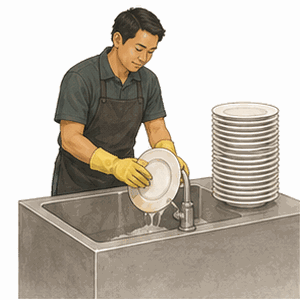
Four people from Job Words. Read the job now, then the job before.







★★★ Choose the form
Look at the subject and the last words. Type am, is, are, was, or were. Then put the whole sentence in the chat.
amisarewaswere
- 1She a nurse last year.
- 2I a student now.
- 3They at work yesterday.
- 4We tired now.
- 5He a cook in 2020.
- 6It cold last night.
- 7You in class last week.
- 8You my teacher now.
★★★ Ask, then answer
Watch the verb move. In a question it jumps to the front. In the answer it comes back.
The answer repeats was or were. Never use did with this verb.
★★★ Make it a question
Make it a question. Move the verb to the front and type the whole question.
- 1He was a driver.
- 2They were at school.
- 3You were tired.
★★★ Fix the sentence
Each sentence is broken in one place. Keep every word and change only what is broken.
- 1I was cook.Say a before a job.
- 2She were a nurse.With she, say was.
- 3We was tired last night.With we, say were.
- 4I was a cashier the last year.No the before last.
- 5They were tired yesterday night.Say last night.
- 6Did you was a cook?Not did. This verb asks with were.
For the teacher · Answer key